Showing posts with label Walks around Paris. Show all posts

Monday, April 11, 2011

Monday April 11 Charters Cathedral and village

Monday April 11 Chartre Cathedral and village

After a day of a needed rest-up I'm all refreshed and off on the early morning train from Gare Montparnasse (this means I have now left Paris from everyone of its main railway station in the City - there are 6 stations). The train was not a TVG but only managed 160kmh according to my GPS. We are very far behind he rest of the world on our public transport in the land of Oz..

Chartres was not a very large city/village, I walked from the station to the Cathedral in about 10 minutes. After checking out what to do I decided I would do the Village walk with an audio guide and return at 14:30 to do the main Cathedral.

I started the walk from the main entrance of the Cathedral and walked around the south side though interesting village streets.Walking past the Canon's house the city wall gates and small clock tower with a 24hour, one had clock. A little audio information about the very famous stain glass windows - I was to listen to an audio on the windows later on in the afternoon.

I then proceeded to the terrace of the Bishop's palace where there was an nice view of the Chartre Town. Then I walked down a long stairway past some very ancient houses and a very old church - Saint Andre collegial church and St Nicolas fountain. Onwards to St Thomas's bridge crossing. the Euro river. Old mills and public washing platforms were pointed out. These were allocated for males on some days then females on other days. In the lower town the river provided a very nice setting the old houses built on the banks and framed by hanging willow branches, the Bouju bridge, and colourful spring blooms in riverside gardens.

We came to a busy village corner where the trail turned and crossed a larger bridge, over a wider branch of the Eure, with some old ruins on either side. An archeological dig was set-up on the far bank with some information signs. The bridge is called the Guilleum (that is: William) Gate Bridge and it was blown up by revengeful German solders as they retreated from the British advance in 1944. There was originally a very large gatehouse with high stone walls.  When I was taking some photos a very old lady shuffled up to me and started talking to me in French insisting that I should take certain photos to capture the importance of the destruction and to emphasis what was there beforehand. She was unconcerned that I could hardly understand her and she dragged me across to a small shop window where there was a collection of old photographs in a frame. It became clear that she was there when the Germans blew up the bridge and that I was very lucky to have this encounter. She was also delighted that the city had been given money to do the archeological research and re-build the old gatehouse.

The loss of culture and history is one of the greatest impacts of the world wars in Europe. WWII caused the greatest loss of life of all wars in human history. Basically big and powerful schoolyard bullies doing their worst to each other and using the simple people and their culture as pawns in their evil games. All the direct civilian bombing done by all sides were direct contraventions of all the "Just War" conventions agreed by all at the time (although the UK did not sign the London Agreement but this omission does means the laws do not apply to them). All these "strategic bombing" "campaigns" and their justification under the cry of "Total War" were war crimes of the highest magnitude and there are many leaders on all sides who should be standing the world court justifying their decisions to use civilians and desperate refugees as tools in their wars.  The politicians who negotiated the Versailles Treat in 1919 are the root course of WWII and nearly all the conflicts since.

From Guilleum's Bridge I walk up the hill passed some beautifully restored old houses, in particular one with an external spiral stairway tower. This staircase was called the Queen Berthe's Staircase. Here I became the curiosity object for some school children who very quickly became very friendly and we conversed in a mix of French and German and they allowed me to take some photos of them. They were very interested in where I came from and how many kilometers I travelled from Australia to get here. They told me that they were out of school on a lunch break and would have to return soon. (Painting of girl added Sept 2011)

I continues down the Flat-Foot stairs back to the river and crossed the Taillard Bridge. There were pretty scene of old riverside buildings and gardens and I re-crossed the river on the Saint-Hilaire bridge to pass the children's school and to briefly visit the Saint-Pierre church with its large flying buttresses and excellent stain glass windows. The  ceiling plaster was falling down and a large net had been suspended underneath to protect people in the church.

A little father up the hill was a smaller church which was also very interesting. The highly decorated ceiling and beautifully painted stain glass windows telling the usual story of the old Testament and the wages of sin. These windows were for the illiterate people to visually "read" the bible as well as to impress them of the importance of the local church leaders at the time.

I continued up Grenet St passing some old houses with interesting brick and stone work facades on the old Citizen's Council Room. Passed the old market place at Billard Square and oldest building called the salmon house because of the fish on the front column.

This was the end of the city walk and I returned to the Chartre Cathedral. I picked up the audio tour of the Cathedral and this mainly deal with the details of al the amazing stain glass windows and who funded the creation of each one. The local weapon makers, the money traders and the shoes makers etc. no doubt guaranteeing them a place in heaven.  The choir stalls were surrounded by panels of intricacy carved picture stories of the life of Christ and Mary of course.

I walked around the inside of the cathedral looking at all the elaborate chapels with many candles burning (2-5 ?? Euros to light a candle - size is important to get the message though)


I got the 5pm train back to Paris and slept all the way.  Luckily Paris was the termination.

I had to finalise my packing for the flight back to Australia on Tuesday.  I had to check Fritz's list to ensure I had watered all the plants and locked up correctly.  Get my overloaded pack and ski equipment thought the Korean Airline weight check proved to be a challenge but a little juggling and some slight of hand got it all through without any extra charge.

Chartre Cathedral and walk through village

Monday April 11 Charters Cathedral and village

After a day need rest-up I'm all refreshed and off on the early morning train from Gare Montparnasse (this means i have now left Paris from everyone of its main railway station in the City - there are 6 stations). The slow train only does a mere 160kmh and I was there is a little over an hour.

Chartres was not a very large city/village, I walked from the station to the Cathedral in about 10 minutes. After checkout what to do I decided I would do the Village walk with an Audio guide and return at 14:30 to do the main Cathedral.

I started the walk from the main entrance of the Cathedral and walked around the south side though interesting village streets.Walking past the Canon's house, the city wall gates and small clock tower with a 24hour, a one hand clock! A little audio information about the very famous stain glass windows - I planned to do an audio tour on the windows in the afternoon.

We (me and my headphones) then proceeded to the terrace of the Bishop's place where there was an nice view of Chartre Town. Then I walked down a long stairway past some very ancient houses and a very old church - Saint Andre collegial church and St Nicolas fountain. Onwards to St Thomas's bridge crossing. the  Eure river. Old mills and public washing platforms were pointed out. These were allocated for males on some days then females on other days. In the lower town the river provided a very nice setting, the old houses built on the banks and framed by hanging willow branches, the Bouju bridge, and colourful spring blooms in riverside gardens.

We came to a busy village corner where the trail turned and crossed a larger bridge, over a wider branch of the Eure, with some old ruins on either side. An archeological dig was set-up on the far bank with some information signs. The bridge is called the Guilleum (that is: William) Gate Bridge and it was blown up by revengeful German solders as they retreated from the British advance in 1944. There was originally a very large gatehouse with high stone walls.  When I was taking some photos a very old lady shuffled up to me and started talking to me in French insisting that I should take certain photos to capture the importance of the destruction and to emphasis what was there beforehand. She was unconcerned that I could hardly understand her and she dragged me across to a small shop window where there was a collection of old photographs in a frame. It became clear that she was there when the Germans blew up the bridge and that I was very lucky to have this encounter. She was also delighted that the city had been given money to do the archeological research and re-build the old gatehouse.

The loss of culture and history is one of the greatest impacts of the world wars in Europe. WWII caused the greatest loss of life of all wars in human history. Basically big and powerful schoolyard bullies doing their worst to each other and using the simple people and their culture as pawns in their evil games. All the direct civilian bombing done by all sides were direct contraventions of all the "Just War" conventions agreed by all at the time (although the UK did not sign the London Agreement but this omission does means the laws do not apply to them). All these "strategic bombing" "campaigns" and their justification under the cry of "Total War" were war crimes of the highest magnitude and there are many leaders on all sides who should be standing the world court justifying their decisions to use civilians and desperate refugees as tools in their wars.  The politicians who negotiated the Versailles Treat in 1919 are the root course of WWII and nearly all the conflicts since.

From Guilleum's Bridge I walk up the hill passed some beautifully restored old houses, in particular one with an external spiral stairway tower. This staircase was called the Queen Berthe's Staircase. Here I became the curiosity object for some school children who very quickly became very friendly and we conversed in a mix of French and German and they allowed me to take some photos of them. They were very interested in where I came from and how many kilometers I travelled from Australia to get here. They told me that they were out of school on a lunch break and would have to return soon.

I continues down the Flat-Foot stairs back to the river and crossed the Taillard Bridge. There were pretty scene of old riverside buildings and gardens and I re-crossed the river on the Saint-Hilaire bridge to pass the children's school and to briefly visit the Saint-Pierre church with its large flying buttresses and excellent stain glass windows. The  ceiling plaster was falling down and a large net had been suspended underneath to protect people in the church.

A little father up the hill was a smaller church which was also very interesting. The highly decorated ceiling and beautifully painted stain glass windows telling the usual story of the old Testament and the wages of sin. These windows were for the illiterate people to visually "read" the bible as well as to impress them of the importance of the local church leaders at the time.

I continued up Grenet St passing some old houses with interesting brick and stone work facades. The old Citizen's Council Room was the best example. I continued past the old market place at Billard Square and oldest building in Chartre called the Salmon House because of the fish on the front column.

This was the end of the city walk and I returned to the Chartre Cathedral. I picked up the audio tour of the Cathedral and this mainly dealt with the details of all the amazing stain glass windows and who funded the creation of each one. The local weapon makers, the money traders and the shoes makers etc. no doubt guaranteeing them a place in heaven.  The choir stalls were surrounded by panels of intricacy carved picture stories of the life of Christ and Mary.

I walked around the inside of the cathedral looking at all the elaborate chapels with many candles burning (2-5 Euros?? to light a candle - size is important to get the message though)

I got the 5pm train back to Paris and slept all the way.  Luckily Paris was the termination.

I had to finalise my packing for the flight back to Australia on Tuesday.  I had to check Fritz's list to ensure I had watered all the plants and locked up correctly.

Getting my overloaded pack and ski equipment thought the Korean Airline weight check proved to be a challenge but a little juggling and some slight of hand got it all through without any extra charge.

Saturday, April 9, 2011

Homage to Monet at visit to Giverny

Saturday April 9 Giverny Monet and Bonnard
Check
(click here) my photo album of Monet's garden.

I was going a little soft on Monet as I was saturated in his Water Lilies and Haystacks and his obsessions with light. In the true abstract tradition that you must not be distracted by reality. But after my visit yesterday to the d'Orsay I had got over this softness and was keen to go to see was he was up to in Giverny.

I used my Eurail pass to get out to Vernon and then rented a bicycle to do the trip to Giverny. I got ripped off. There was a big hassle at the bike rental area as many had got off the train and headed straight for the bike shop. Being in the 1st class carriage I got there first and was protecting my allocated bike. The bike looked at a glance like a good mountain bike and I first checked the brakes and they were well adjust so I make a generalized decision that all else was ok and gave up my money. It was the worst bike I have ever ride. It was a 21 speed bike and the rear cluster would not change passed number 3 which meant I was peddling really fast. The back wheel I soon realized was buckled and was rubbing on the brake pads every turn. The seat looked ok but it was hard and hit all the wrong spots.

I rode around the old village of Vernon trying to find the information de tourist to get a map and also buying my lunch and keeping to the RIGHT side of the road. At the deli the shop keeper refuse absolutely to sell me 50 gms of jellied beef and emphasis that the smallest piece she would sell was 250gm. I could have bought my lunch for less. But the jelled beef looked nice (as was) so I parted with my euros. The girl at the tourist office was very pleasant and gave me the map I needed by didn't tell me that there was a nice safe bike track all the way to Monets house. She indicated that I follow the main road. The building this office was in, and all the building beside it, was leaning substantially to the right that they must be close to collapse. But inside the office was fitted out in as a modern office with no concern as to the fact it could all fall down at any moment. (I had noticed this problem in Amsterdam as well)

It was only when I started of the 7 km ride to Monet's house that I began to realize that the bike had problems - there had been too many distractions in the village to pickup any problems as It took me some time to workout how to change the gears by the twisting the handgrip close to the brake. I crossed the bridge over the Seine River and took some photos, then turned right at the round-a-bout and headed along the river flats to Giverny. After a few kilometers a local stopped me and told me that I would be happier of the bike track and indicated when I could join it. The cars whizzing past me had been worrying but French driver are very good and always consider bike riders. I was always aware that drivers were slowing and give me (and any other bike rider) space.


The bike track was a much more pleasant ride and I was able to look at the houses as I went by and to watch tradesmen working on roofing tiles etc. The village on Giverny was a simple street village with the church on the high point.

There were only three things to do in Giverny: Monet's garden, the Impressionist gallery and Monets grave. I stopped in front of Monet's house and saw the long queue of tourist (I'm not one of them of course) so I stopped by a park bench and ate my expensive lunch. When I joined the queue is was very short (the tourist were all at the very expensive restaurant) and I got in straight away.

The entrance was though a small side cottage and not the main house. It contain the essential Museum Shop to get even more money out of the tourist pockets, I often wondered why they even charge admission at Museums but then they know there are mean spend-thrifts like me and they can't let them though the door for nothing.

On exiting this little building I was "hit" with the garden.

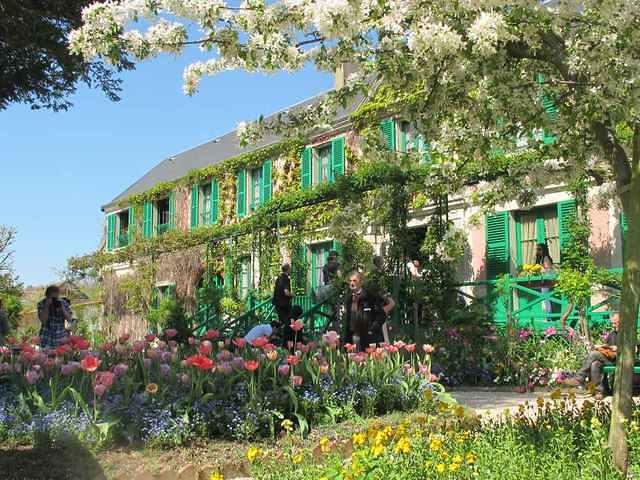
It was an incredible sight which just got better and better as I walked through it. I was stunned. I have never seen flowers as big and as colourful as these here. Very large flowers of every colour planted carefully beside other colourful small flowers of suitable close or contrasting colours. Monet planted this garden as if it was a painting. I continually took photos to tried and capture this contrast.

The little paths guided me to an under-pass. A railway, and then a road, had been build through the centre of Monet's garden many years ago - clearly the village planning bureaucrats had no idea of the value they were trashing. This took us under the road to the waterways and lake which Monet constructed to make his Japanese bridge and water lily garden.

This was truly a wonderful place. Each turn of the track gave yet another vista to glimpse this bridge (a reconstruction and not the original bridge we were told) across the lake with the willow trees hanging branches and leaves partially obscuring the green bridge. An enormous amount of coloured blooms were arranged around us as if a huge painting brush was swooping down and splashing colour in all the right places.

I'm running out of words and I have put up a photo album of the garden at the top of this post.

It was clear the Monet was not poor in his time as the house was well appoint with a very nice wood burning iron kitchen stove and oven. The utensils were all copper and the house generally would have been very comfortable to live in. The views across to the Seine River were very pleasing and restful. Entertainment at this time of the year would have been most enjoyable.

I left the house dazed with colour and rode back along the street to the Impressionist gallery to see the Pierre Bonnard exhibition. This was a prize for me as I have always admired Bonnard and have come to think that he had found the right point between representation and abstraction. I was to now look at 80 of his work be did while living in Vernon as a close friend of Monet and the usual crowd of impressionist artist of the time.

His 1930 'Self Portrait" --- great

1920 'The Head of a Woman' --- great


1924 'Reflecting on the day'


1913 'Standing nude from behind' --- great painting

1939 'Terrace at Vernon' --- one of a number of great landscapes


1920 'The Balcony at Vernonet'


Other great painting which I have not yet got images were:
1916 'The Lunch'
1915 'Nude before Mirror'
1925 'Nude at her bath'

Audio commentary quote: "Bonnard's start his painting in a space that is already abstract"
Bonnard would do his initial painting from a model and then complete the painting from his memory!!

I bought a same English language book on Bonnard at the Museum shop and the Bonnard images above are photographed from this book as they wouldn't let me take photos in the gallery.

I slowly rode back to Vernon giving unnecessary thought time to how I was going to get a refund from the guy who had rented me this bike. I had to get the train at 6pm and rode around looking at the bridge gatehouse which was a four-tower cluster with slate conical rooves. The remain of the old bridge stone work stretched out across a narrow channel of the Seine to an island and the section over the main river channel was gone completely.

I rode around the Vernonet section of the village of Vernon and explored the narrow street and alley ways. I came across a tavern where there were men playing the French bowling game of Petanque. This is played with 8 Steel Boules in a set. A small plastic 'jack' is thrown out on the ground, which can be anywhere that is basically flat, it doesn't seem to matter if the are plants and trees about. It all works out. The steel balls are them thrown (not bowled) towards the jack with a carefully crafted 'back-spin'. The thrower does this so when the steel ball hit the ground they don't roll quickly forward but slow and go to the right or left depending on the thrower's spin. They have to get closest to the jack (as in our bowls) and may knock opponent's ball out of the way. It is always watched by spectators giving unwanted advice. A few minutes of entertainment for me to watch real pub culture in action.

I rode back across the Seine bridge and thought the main village, where I bought a very nice pistachio ice cream, very nice after a long ride. I then took my bike back to the bike shop and tried to make my point with the man. He tried to trivialised my complaint and when I loudly pointed out the problem he immediately disappeared. Another shop person arrived and I try to tackle the problem with him and he denied that there anything wrong with the bike (language is no problem here - its all gesture and noises). Finally the original guy returned with my deposit and tried to avoid the problem. The only support I got was from the crown around but the bike men keep up the pretense of 'being too busy'. I gave up of course.

The train came and it was nice to have first case seats to escape into sleep for an hour. I woke with a start thinking I had gone passed my station but Paris was the termination of course. I returned to the Ile St Louis by the now very familiar metro.

Friday, April 8, 2011

Return to the Musee d'Orsay

Friday, April 8 - Paris
I arrived in Paris at about 9:30 and got to Ile St Louis at about 10:30. After a short break, I headed off by the metro to the d'Orsay Gallery for a second visit.

By a stroke of luck, an exhibition of Manet had just opened and I paid a minuscule 2 euro supplement to see it.

The Manet exhibition was really good. Many of the old favorites, Olympia, Berthe Morisot. I was disappointed to see only a preliminary painted sketch of the "Gare Saint-Lazare" the real painting is still in Washington. Likewise, Manet's great work, the "Girl behind the bar at the Folies-Bergere" was still in London. I would have hoped, for an exhibition of this size, that they would have been included. It was great looking at the brush strokes and following Manet's development as an artist fighting the critics all the way. I was surprised at how hard he tried to please them.
The main d'Orsay gallery still has a huge collection of his work.

The main d'Orsay gallery is really the major impressionist gallery. It has, I believe, all the best of Monet's paintings. The Japanese bridge, the water lilies, and the Rohan Cathedral (x 4) plus many others. I know I raved over the water lilies in the Orangerie gallery but I've changed my mind. The d'Orsay wins. But I still stand by my comment on the Mammottan it has all Manet's practice paintings.

The same applies to the other impressionist d'Orsay who have the best of Renoir and Degas plus Cezanne, Bonnard, and the others. I found myself re-visiting rooms to see the paintings again. Renoir's "Dancing at the Moulin de la Galette" is breathtaking.

the d'Orsay has a decorative art collection and the room which impressed the most was a complete reconstruction of a furnished room in Art Nouvelle woodworking.

I left the gallery at about 6pm and looked for a restaurant. After trying the top restaurant in the d'Orsay and a few others on the way home, I couldn't find a menu with a decent-sized helping and a reasonable price. So I pick up some veges etc and walked back to the Ile St Louis and cooked my own dinner.

Saturday, March 12, 2011

Montmartre - Saturday March 12

Saturday March 12

Today I was to follow Degas and Renoir through the Montmarche district. I caught the Metro to Clichy Place (where I finished my last Impressionist walk) and walk to the site of the Cafe Guerbois, the gathering place of the impressionist, the "Guerbois Group" where Manet lead the discussions over coffee with Renoir, Monet, Degas, Cezanne, Bazille, Latour, Pissarro and the writer Emile Zola. Manet drew "At the cafe" here. It was an important place but it was now gone. I breathed in air they breathed, as it was all that was left. From here I walk to the house where Latour painted the famous painting of Manet and the impressionist team in Bazille's Studio "Studio in the Batignolles". It was at number 9 rue de la Condamine, but only 7 and 11 were marked. More air, but I was walking their walk.

From here I headed toward Montmarche and dropped at the Montmarche cemetery to pay homage at Degas' grave. Then I walked down the Boulevard de Clichy to the Moulin Rouge. Shock-horror the tourist were there in flocks. I had to wait for a huge white bus to move to get a photo. The Moulin Rouge is still there but has morphed into this century as a marketed apparition n - big red windmill (Moulin) as well.

I then began to wind my way up the hill towards the great Cathedral Sacre Coeur, walking up the steep and winding Rue Lepic and passing a place Van Gogh lived for a while. (crowded with tourist packing all the stand tourist traps) At the top, at the intersection was a dilapidated park with a green wrought iron arch over the gateway spelling out "Moulin de la Galette". Could this really be the place where Renoir painted his master piece "Dancing at the Moulin de la Galette" I wondered? I studying the painting in my book and nothing seemed to match. I took some photos and move on and up. This time I checked house number and I found 79 rue Lepic and a 83 there was a cafe named "Moulin de la Galette" and it had a windmill on top. This area was flatter and was a more like a place for an open-air dance. More photos.

I continued to follow the winding streets (trying to avoid the tours and taxis) which suddenly open out onto the Place du Tertrer when all the want-a-be artist sell the trade. I walked among them all and assess most paintings as "kitsch" with over use of colour and facial distortion faking some sort of abstraction. I must admit them were a few which were excellent. Particularly the portraits. I tried to photo the portrait artist doing their instant portraits. It was fun attempting too line-up the subject, painting and artist in the one photo. I was impressed with some of the artist of their ability to capture the essence of a face.

After getting over the shock of the tourist crowd at the cafes and shops I move quick onwards and upwards to Sacre Coeur missing Renoir's studio where he worked on "Dancing at the Moulin de la Galette" (damn!!). The Cathedral was awesome. Its post ion was commanding. The view over Christendom Paris was total. I followed the crowd into the Cathedral and secretly though some interior photos. I pause in the area at the front of the Cathedral to look at Paris and realised just how much of Paris I now knew and have seen (and there is much more to see). I slowly descended the great stairway down, taking the occasional photo, to have a late lunch in the children's park at the bottom. The weather had turned very cold and I actual though it might snow.

I still was following Degas and made my way to the Place Pigalle were he lived. His famous painting of the couple seated in a cafe "Absinthe" was painted in a cafe there. It was gone of course, replace by a modern cafe and the street was now all sex shops. A pretty girl glance at me from a shop window, I felt flattered, but when she had assessed the size of my wallet she quickly looked away - ho hum.

It was getting late so I headed for the nearest Metro station (Le Peletier) which would take me directly to my comfortable refuse on the I'le St Louis.

Friday, March 11, 2011

Versailles

Friday March 11

Metro to Versailles Chateaux Rive Gauche and then a short walk to the Chateaux.

The grandeur and opulence of these kings and queens was overwhelming. No wonder they never noticed the people were starving. The private bed chambers, the consulting rooms and the entertainment rooms and then the Hall of mirrors were all incredible. Louis would talk about being open to the people but clearly missed the point.

The garden were their backyard. A fascinating arrangement of playful fountains and mazes. With Marie's little country get-a-way in the corner. Her little theatre was like her cubbie house where she played at being an actor.

Unfortunately none of the fountains were going as it is winter and of cause all the trees are bare. I "might" return to see the gardens in mid April. The fountains are only switched on from May to September. Most of the statues were covered to protect them from the winter freeze.

The visit took me all day. The main building took 4 hours and the garden another 4 hours. So much wealth in the face of poverty. Revolution had to happen.

The value that Louis placed on science and the arts has come through and made Paris into a cent re of culture. So some good came out of it all. Bonaparte, despite his terrible wars and crowning himself king, consolidated these cultural values and set up a legal system and a bureaucratic order. The rebuilding of Paris caused a few problems and much discussion at the time.

I came out of the gardens with mixed feelings.

Saturday, March 5, 2011

Galleries & Monuments: Monday Feb 28 to Friday Mar 4

Monday Feb 28
Today my mission was to see the Orangerie Gallery and also the Delacroux's house galley.

Orangerie is a collection of paintings by Guillaume Rogers. Found the Renoir collection very interesting but the most amazing galleries were the two upstairs galleries built especially for Monet's major achievement of 8 HUGE painting of his water lilies. After seeing many of Monet's "practice paintings" of water lilies at the Mamottan Monet gallery I was really taken a-back when I saw these. I returned to these rooms again before I left just to refresh my mind. I was so much to take in. The rest at the Orangerie Galley was great and really worthwhile to see. The Renoir collection ("R-n-wa" no e) and I now know some new names that I now need to follow up.

(check photos and add nomes here)

The Delacroux's house galley was a waste of time. I have been very impressed with Delacroix's painting in both the l'Orsay and the Louvre.

Tuesday Mar 1
At home day.
Catalogued all my photos and did a pencil drawing of the St Michel Chapel in the Torrent of Vallon valley when we were ski recently.

Wednesday Mar 2
Planned this day better and managed to achieve all visits (a number as closed for various reasons)
Started by returning to Delacroix's house again. I took a short-cut along the nice and narrow street St Andre des Arts to Satre-Beauvoir Place. This is the area where to modern Philosophers gathered in cafes). I came to see the Church, St German des Pres, a very old Romanesque architecture containing the tomb of the philosopher Descartes.

I then headed along Rue Bonaparte to St Sulpice Place and the 2nd largest Cathedral in Paris. It has two towers and inside I found a chapel with 3 Delacroix paintings. An interesting fact I discovered was that he mixed his paints with molten wax to preserve the paintings. Looking closely at the painting you could see the wax and it must have been very difficult to apply.

I was then off along the rue Garancieve to the Palias du Luxembourg and the gardens. The building is the government office for the senate and not accessible. The Medici wife of King Henry IV built this palias to remind her of her Italian home. It is a very beautifully set out garden, currently without flowers or tree with leave. The fountain pond and tree and the vista to the Pantheon were all very nice. The long view down lawn back to the Palais was impressive. It is now used by local students for social cafe and exercise along the many paths and playing areas.

Leaving the garden and heading along the avenue de l'Observatory I passed the famous "Fountain of the four parts of the world". This was a particularly beautiful fountain with the four maidens looking very graceful as they carried the world on their shoulders.

I was heading toward the Paris Observatory hoping to see the time marker - unfortunately it was close for renovations. I continued on to the Place Denfert Rochreau where there was a huge sculpture of a lion in the centre with all the car circulating around. I was here to see the Paris Catacombs and they were hard to find. In fact the entrance was right in the Place but the only sign post pointed away from the Place. The Catacombs of Paris are old abandoned limestone mines (abandoned because of serious subsidence cause the building above to collapse) which were re-used to bury the Paris dead because of heath problem arising from cemeteries within the city. All bones, with occasional little chapels for service. Signs told us that some were exhumed from city cemeteries of were the dead from specific revolutions. All very neatly and respectfully arranged skulls and bones in their thousands. It was very interesting but a bit macabre. (There is an other museum which takes you into the sewers of Paris. I'm no sure that I am ready for that one.)

From here I headed along the rue de St Jacques to the Pantheon. An impressive piece of architecture and geometry, even though the early attempt at using steel for reinforcing concrete is now failing and bit are falling off the building. The building was first built as a church but under Napoleon it changed to be a "secular public building" for special occasions and for the burial of significant Frenchmen. Madam Curie, Victor Hugo, Voltaire Rousseau and Emile Zola are in the crypt.

At this point I was keen to get back to the I'le St Louis and headed along St Germain Bd - bought some veges and bran - I'm getting to know the local shops. I found an interesting and not-on-the-tourist-route church - (Can't find its name) I did not take any photo as it was full of people actively praying at all the various chapels to saints. It to me that France is a very Catholic country (surprise!!)

A very trying day. I did not use the metro as I still find it fast to walk to palaces and I like to take interesting streets and see the life. There is a lot of darkness in the Metro tunnels and you don't see much.

Must plan tomorrow. Friday I have to pack for the ski trip to Nice (Tende). They have had a lot of snow this week.

A Norwegian friend of Fritz (uno) who is coming on the ski trip will be having dinner with us tomorrow night. (the conversation will be in English!!)

Thursday Mar 3

Another better planned day.
Caught the metro to Madeleine Metro station and emerged from the underground to find myself beneath towering columns
Madeleine
Elysee Palace
Impresioinist walk around the Place de Europe
Paris Opera house
(complete)

Friday Mar 4
Napolian's tombe and the Musee Rodin with Uno.
(complete)

Monday, February 28, 2011

Galleries & Monuments: Tuesday Feb 22 to Sunday Feb 27

Tuesday Feb 22
We arrived at the Gare Asterlitz at 7:30 am then walked back home to the I'le St Louis. I spent the morning resting and organising photo and writing. I have booked the overnight trains to Nice for our next ski trip when we were in Biancon, I also needed to give some thought to my Barcelona trip.

In the afternoon I went out shopping for food and did a quick walk around the island.

Wednesday Feb 23
I had to return the Avalanche beacon (called ARVA's in France) to the shop "La Haute Route" 33 Boulevard Henry IV. Hence I decide to include a walk to the Bastille and learn about all that "storming" that went on there.

I found the shop ok and returned the ARVA and tried to get a goretex patch kit to repair Fritz's pack (my ski bindings had put a hole in the pack he lent me). They sent me to "Vieux Campeur at 48 rue des Escoles. This was just across the Seine and in the Latin Quarter of the city (so called because it is the university are and long ago all teaching was done in Latin and everyone in this area spoke in Latin). But first i was now on my way to the Bastille. The Bastille was a great fortress which became a prison and the old plan is marked out in cobble stone around the Place de la Bastille. The prison was not a popular place and was to focus of the revolutionaries in July 1789. The current column was built 50 year later to commemorate and record the name of those who died in the storming.

I walked back down Boulevard Henry IV across the river and found the Veux Campeur shop and got the repair kit. Makes me feel a bit happier. Returned to the I'le St Louis and am beginning to feel comfortable around the city.

Thursday Feb 24
Set out to do make a start on the biggest project - the Louvre. I had previously check out the Louvre and got the necessary maps. I planned, and completed, to do the 1st floor only - the old masters from the 14th C to the 17th C. It was hard work and I had to control my time carefully.
Following the development of detailed painting and design of mainly religious subjects. (The cost of paint was prohibitive and these were all commissioned art). To greater understanding of drafting the human body and much later understanding perspective. The colours improved in the 17th C and design became more important. By the 18th C there was much of the beginning of impressionism. (update more later)
I was able to photograph all the paintings and notes (in French!!) I found interesting. I will publish these in my photo album on filsonplace.com (soon)

This floor took me all day to cover.

Friday Feb 25
I planned a big day. First I wanted to see the important sites on the I'le de la l'Cite. The other big cathedral - St Chapelle, The Palias de Justice and the Conciergerie. These 3 took all day and I had to revise my plans. I also bought a 4 day Musee Pass It was very cost effective and by the end of the day I was 20 euro ahead).

Saturday Feb 26
Back to the Louvre to do the 2nd Floor - Flemish, Dutch, German and a huge section of French paints all covering the period 14th C to 18th C.

Again,I was able to photograph all the paintings and notes (in French!!) I found interesting and will publish these in my photo album on filsonplace.com (soon)

Click here to link to Louvre 2nd floor photo notes

Sunday Feb 27

I set off to do the Arc de Triomphe and Tour de Eiffel to get the best out of my 4 day Musee pass

Standing on top these huge monuments was amazing. Paris has been "height restricted" to maintain the old character of the city and being so high above gave me the same aerial perspective as the first scene of the movie Moulin Rouge. I felt I could zoom down into the streets of Paris. I squeezed in two more Mussees - A science Museum in the Grand Palace - which is a great science learning centre for kids, and the Petit Palace where I saw some nice Monet and Cezanne paintings.

I managed to master the Metro today.

Wednesday, February 23, 2011

Storming the Bastille

Wednesday Feb 23
I had to return the Avalanche beacon (called ARVA's in France) to the shop "La Haute Route" 33 Boulevard Henry IV. Hence I decide to include a walk to the Bastille and learn about all that "storming" that went on there.

I found the shop ok and returned the ARVA and tried to get a goretex patch kit to repair Fritz's pack (my ski bindings had put a hole in the pack he lent me). They sent me to "Vieux Campeur at 48 rue des Escoles. This was just across the Seine and in the Latin Quarter of the city (so called because it is the university are and long ago all teaching was done in Latin and everyone in this area spoke in Latin). But first i was now on my way to the Bastille. The Bastille was a great fortress which became a prison and the old plan is marked out in cobble stone around the Place de la Bastille.  The prison was not a popular place and was to focus of the revolutionaries in July 1789. The current column was built 50 year later to commemorate and record the name of those who died in the storming.

I walked back down Boulevard Henry IV across the river and found the Veux Campeur shop and got the repair kit. Makes me feel a bit happier. Returned to the I'le St Louis and am beginning to feel comfortable around the city.

Tuesday, February 22, 2011

Rest day after ski trip to Nevache

Tuesday Feb 22
We arrived at the Gare Asterlitz at 7:30 am then walked back home to the I'le St Louis. I spent the morning resting and organising photo and writing.

When we were in Biancon I booked the overnight trains from Paris to Nice and on to Trende for our next ski trip.

I also needed a day off to give some thought to my Barcelona trip.

In the afternoon I went out shopping for food and did a quick walk around the island to brush up on the surrounding shops and services. The French say you must go out every day in Paris.

Wednesday, February 16, 2011

The Marmottan-Claude Monet Museum

Wednesday Feb 16, 2011
To continue my quest to follow the impressionist trail I set out at 10:30am (a little late) and headed to the St-Michel Notre-dame metro/RER station. After a bit of delay when the only ticketing machine was being "re-booted" I finally got my tickets and was on my way. I got off at the Boulainvilliers-La Muette station. Thinking this double name station was all one station I headed off to walk to the museum. Very soon I relaise that navigation was not going well. A quick adjustment though some narrow street I was back on track, Probably lost 15 minutes or so but I saw some additional Parisian community life which wasn't on the plan - that's OK. I arrive at Muette Place and then proceeded along the rue Ranelagh to the Marmottan-Claude Monet Museum. I pause to have lunch in a large park just before the Museum and, being winter, all trees were bare and the garden were all being prepared for the cold and plants were being dug up.

My description of the Marmottan Monet gallery will have to wait as Fritz has come in and explained the details of the Ski trip they are planning now - looks great. We are leaving on the 2300 night train to Bradonecchia (near Genolble in the south). We now have to do some planning and prepartion. I'll have to go to the Orangenie Museum on Thursday because I have a ticket - a lot to fit in but I should have time to up-date this post on Thursday.


The Marmottan Monet gallery
This is a very large collection of the rest of Monet's work by family and private collectors. While it does not contain many of Monet's best painting there are some that are very interesting.
eg
Gare St Lazare 1877
Impressie Soleil Levant 1872
Paintings of his children, Portrait of Bertha Morrison. (I'll add more from my notes later)
There was a nice portrait of Claude Monet and Madam Claude Monet both by Renoir

In general I found this museum an educational exercise and allowed me to see the development of Monet's thinking as he got older and diverged from his impressionist compatriots. The large number of Water Lily painting where almost overwhelming as were the many Avenue of Roses, the Basin of Nymphs and the Japanese Bridge. He spend a huge amount of his time constructing his garden in Girverny. You could see the development of his ideas on light and reflections. This collection are, in the main, a collection of his experimentations. Monet's successful works are found in the major museums as the Mussee d'Orsay.

After studying Monet for some days now I have come to a personal stand that I have a preference and respect for the technical mastery of Manet and the brilliance and colour of Renoir. I believed they achieved real results while Monet was experimenting with abstraction in landscape.

It Museum was an important for it educational value.

Tuesday, February 15, 2011

Walk on the left bank and the Musee d'Orsay

Tuesday Feb 15, 2011
Fritz came down for a morning coffee and he spread out a couple of topo maps and we discussed possible skiing areas for our first ski trip. We decided we would do a trip on a large limestone plateux in the area between the town of Die and the City of Grenoble. We went over the maps and planned some possible routes. We many have to camp out one night in a simple shelter.

Today I planned to walk the streets of Paris and not get the metro. I wanted to get a feel for where things are in the city and to observe what people do each day. I set out about 9:30 am to go to the Musse d'Orsay where most of the Impressionist painting are now hung. I chose a route which passed the birth place of Edouard Manet and also to find the studio of Frederic Bazille, which both Claude Monet and Auguste Renoir were invited to share with him while they all attended the Ecole des Beaux-Arts. So I retraced my steps back to Notre Dame, took some photos of the butresses, then crossed to the left bank of the Seine and walked along the "quai's" to the Pont Neuf. I crossed this bridge briefly to see from where both Monet and Renoir did their paintings of it in 1872. I continue back on the left bank and visited Manet's birthplace a 5 rue Bonapart. It was being renovated and the old man in the shop at number 3 knew nothing of Manet's birth place. Originally there was a plague on the door post but there was no sign of it. I continued a little further to 20 rue Visconti, the studio of Bazille and on to have lunch in the Cafe la Palette, a favourite haunt of Artist in the area.

At 1pm I headed for the Musee d'Orsay and spent 1/2 hour in a queque to get throught the security to get inside. This was an amazing experience to see so many of the famous paintings which I had studied, and sometimes spent long days copying, right there in font of my eyes. The painting were so much brighter than the prints I had seen. Monet life long work on relected light was so clearly successful, as were the paintings of the hay stacks and the mpany view of the Cathederal at Rhoan. Renoir's great painting of 'Dancing at the Moulin de la Galette" was so colourful and bright. Manet's great skill was ever so evident in many paintings. I will have to document all the painting that impressed me.

I return to the Ile Saint Louis at 6pm and shopped for food at the local shop. My French got a workout but I found everyone was tolerant and other customers were quietly help. Asking for 'cooking oil' was a challenge but buying my vegetables and bread worked our well.